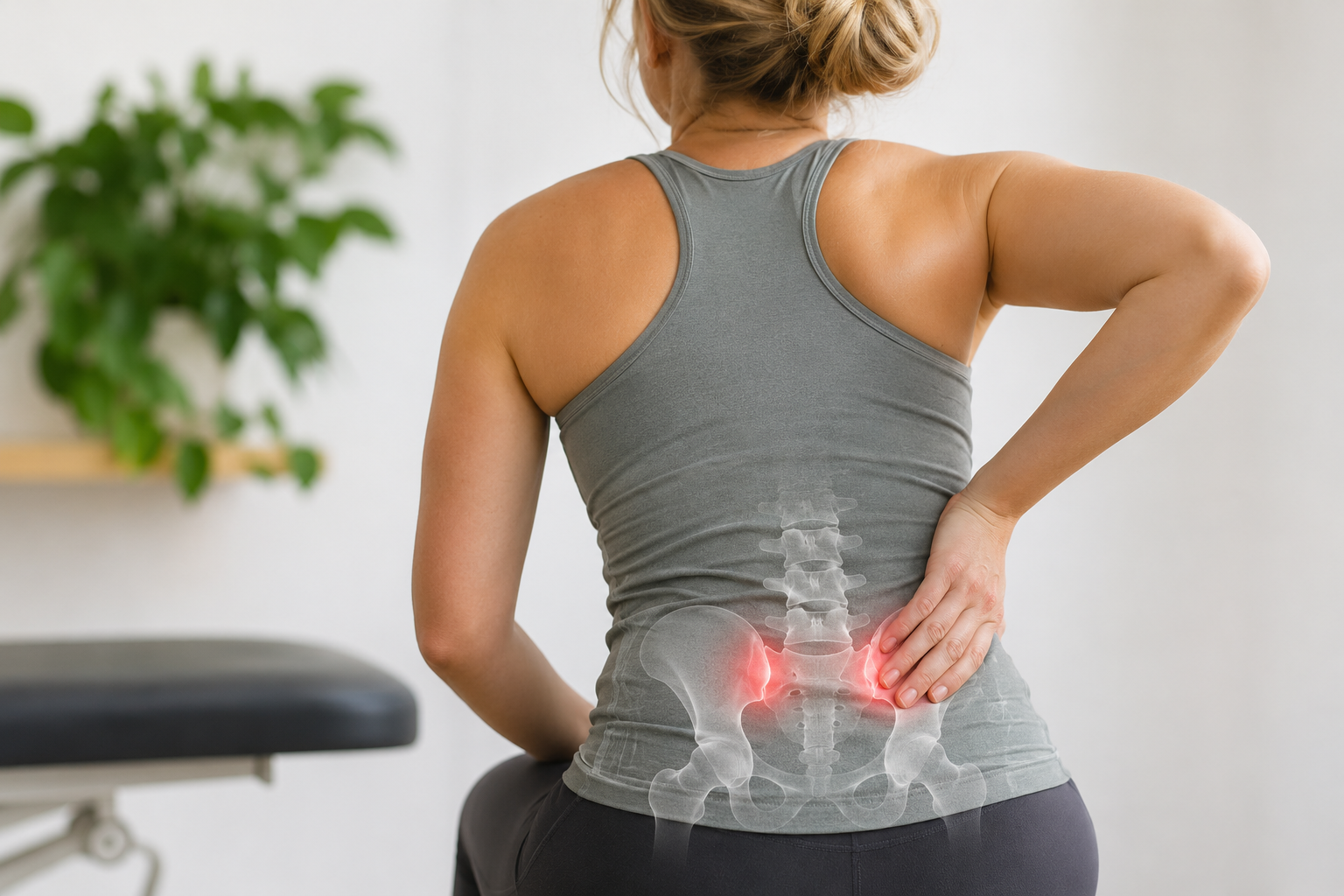
Pain around your lower back or buttock can make everyday activities, from getting out of a car to carrying shopping, feel more difficult. Sometimes, the sacroiliac joint or the tissues around it may contribute to that pain.
The good news is that there are several ways to manage symptoms and work towards returning to the activities you enjoy. Here is what you need to know about sacroiliac joint pain and how an osteopath may help.
What is the sacroiliac joint?
You have two sacroiliac joints, often called SI joints or SIJs. They sit at the back of your pelvis, one on each side, where the triangular bone at the base of your spine meets your pelvic bones. These joints move only a small amount. Together with the surrounding muscles and ligaments, they help transfer forces between your upper body and legs when you walk, lift or change position. Pain can arise in or around this area, but it is not always possible to identify one exact structure as the cause. Having pain does not necessarily mean your pelvis is “out of alignment” or needs to be put back into place.
What can contribute to SIJ pain?
There is rarely a single explanation for everyone. Possible contributing factors include:
Pregnancy and after birth: Changes in the body and the demands of pregnancy and caring for a baby can be associated with pelvic girdle pain, which may be felt around the SIJs.
A fall or injury: A direct impact, sudden twist or other trauma can irritate the region.
Changes in activity: A sudden increase in lifting, running or other physical demands may contribute to symptoms.
Walking patterns or leg-length differences: These may be relevant for some people, although a difference does not automatically cause pain or need correcting.
Hypermobility: Some people have joints that move more than usual. This may be one factor considered alongside symptoms and other findings.
Inflammatory conditions: Certain forms of inflammatory arthritis can affect the SIJs and need medical assessment and treatment.
Your osteopath will consider these possibilities in the context of your health, rather than assuming that one factor is responsible.
What does SIJ pain feel like?
SIJ-related pain is often felt on one side of the lower back or buttock, although it can affect both sides. Some people also feel discomfort around the hip, groin or leg. Activities such as standing on one leg, climbing stairs, rolling in bed or getting in and out of a car may aggravate symptoms. Pain in this area is not always caused by the SIJ, as the lower back, hip and surrounding tissues can produce similar symptoms, and more than one area may contribute. That is why a careful assessment matters.
How does an osteopath assess SIJ pain?
Your appointment usually begins with a conversation. Your osteopath may ask when the pain started, what makes it better or worse, how it affects daily life and whether you have experienced an injury. They may also ask about pregnancy, your general health and symptoms that suggest another cause. The physical assessment may include watching how you move and examining your lower back, hips and pelvis. Your osteopath may use a group of provocation tests: gentle movements or pressure applied in different positions to see whether they reproduce your familiar pain.
No single test can definitively confirm that the SIJ is the source. The results are considered together with your history and examination, including signs that the pain may be coming from somewhere else.
Will I need a scan?
Not necessarily. For many people with lower back or pelvic-region pain, a history and examination provide enough information to begin care. Scans do not always identify the source of pain and may show changes that are not responsible for symptoms. Imaging or further tests may be useful when there has been significant trauma, when an inflammatory condition is suspected, or when symptoms suggest another condition that needs investigation. Your osteopath may recommend seeing your GP to discuss this.
What can help manage SIJ pain?
A plan should reflect your symptoms, preferences and goals, and is catered to your individual needs.
It may include several approaches:
Exercise and managing your activity
An individually tailored exercise program may help you build confidence and capacity for everyday activities. Depending on your needs, it might include exercises for the hips, buttocks, trunk or pelvic floor, as well as a gradual return to walking or other activities. “Load management” means adjusting how much you do while symptoms settle, then building up gradually. For example, you might temporarily shorten a walk, break up lifting tasks or change how you carry your child. The aim is usually to keep moving in manageable ways, not avoid activity altogether.
Manual therapy
Your osteopath may offer hands-on care, such as gentle soft-tissue techniques or joint mobilisation, if appropriate for you. Some people find manual therapy helpful for symptoms or movement, but the evidence is not strong enough to promise that it will work for everyone or provide lasting relief on its own. It can be considered alongside exercise and self-management, rather than as a replacement for them.
Education and support
Understanding what may be contributing to your pain can make it easier to choose comfortable ways to move and return to activities. You and your osteopath can discuss what is important to you, track your progress and adjust the plan if it is not helping.
Interventions such as Pelvic belts
A pelvic support belt may be worth trying for some people, particularly during pregnancy-related pelvic girdle pain. It is not necessary for everyone, and research on its benefits is mixed. An Osteopath can help you decide whether a trial is appropriate and comfortable.
Medical review and injections
If symptoms are not improving, are worsening, or suggest an inflammatory or other medical condition, your osteopath may recommend a GP review. Your GP can consider further investigations or referral. For selected people with persistent pain, a specialist may consider an image-guided injection to help investigate or manage symptoms. An injection is not usually the first step and is not suitable or effective for everyone.
Practical self-management tips
Keep moving in ways that feel manageable.
A short walk or gentle change of position can be a starting point.
Break demanding tasks into smaller parts and allow time for recovery.
Experiment with comfortable positions for sleep, sitting and lifting.
Notice patterns in your symptoms, but try not to judge every movement as harmful.
Ask for help tailoring activities during pregnancy, after birth or while returning to work or exercise.
If an activity causes a substantial or lasting increase in pain, scale it back and discuss it with your osteopath.
When to seek urgent help.
Go to an emergency department immediately if you have back or pelvic-region pain with new difficulty passing urine, loss of bladder or bowel control, numbness around the genitals or bottom, or new weakness in both legs. These symptoms can signal a serious spinal problem that needs urgent assessment.
If pain around your lower back, pelvis or buttock is affecting your day, you are welcome to book an appointment with us at Elevate Osteopathy. We can listen to your concerns, assess your symptoms and work with you on a plan that suits your needs.